Wondering whether ribs should fall off the bone or hang on with a little tug? We got you.
Competition judges want the tug. In 2018, the Kansas City Barbeque Society’s rules committee told its judges that bite and mouthfeel govern tenderness, that the meat should have some firmness without being tough or chewy, and that it should never be mushy or dry. Fall-off-the-bone is a different target, and you hit it the same way you hit a clean bite, with time and temperature. Our pork rib recipes pull anywhere from about 190°F to 210°F, and where you stop inside that window decides the texture.
Pick your texture first. Then pick your rack.
🏆 What barbecue judges look for in a rib
KCBS judges score every entry on taste, appearance and texture, according to the society’s own FAQ, and ribs are one of its four meat categories alongside chicken, pork and brisket. That 2018 tenderness language gives judges words to score against and no temperatures at all.
Read it the way a pitmaster does. A competition rib gives way where you bite and leaves a clean bite mark, while the rest of the meat stays on the bone. When the whole bone slides out at the first tug, the meat has usually crossed into the soft, mushy territory KCBS tells its judges to avoid.
None of that is a rule for your backyard. Plenty of people want ribs that collapse, and every recipe below tells you which texture it’s built for.
🌡️ How to steer rib texture on purpose
Ribs are a tough cut held together by collagen, the connective tissue between muscle fibers. America’s Test Kitchen explains that collagen starts breaking down into gelatin once the meat passes about 140°F and converts best when it holds between 160 and 180°F for an extended stretch. That is why ribs cook low and slow, and why they keep softening long after they pass pork’s 145°F safe minimum.
Temperature is your first lever. For bite, we pull pork ribs around 190 to 200°F, and for fall-off-the-bone we let them ride to 205 to 210°F. Wrapping is the second. Foil traps steam and braises the rack in its own juices, which speeds things along and softens the bark, while an unwrapped rack that gets spritzed keeps more chew and a firmer crust. The third is the bend test: lift the rack from the middle with tongs, and if the surface cracks and the ends sag, you have bite. If it threatens to tear in half, you have fall-off-the-bone.
Set yourself up before the fire. Pull the membrane off the bone side using our guide on how to trim ribs, match your smoke with the best wood for smoking ribs, and check doneness with a Thermapen slid between the bones, not touching them. Our ultimate meat temperature guide has every number in one place.
🐖 Smoked pork ribs

Smoked pork spare ribs
Spare ribs trimmed St. Louis style, rubbed the night before, then hung in a drum smoker at 225 to 250°F and spritzed, never wrapped. We pull them at 205 to 210°F, squarely in fall-off-the-bone territory. Get the smoked pork spare ribs recipe.

Smoked St. Louis ribs
An overnight rub over a mustard binder, rib hooks in a barrel smoker at 225 to 250°F until 195 to 200°F, then sauce and a quick sear on the grill. Tender, juicy and sliced between the bones to serve. Get the smoked St. Louis ribs recipe.

Dry rubbed smoked baby back ribs
Baby backs, the smaller ribs from up near the backbone, smoked vertically in a barrel cooker at 275 to 300°F for about two and a half to three hours. No foil, sauce only in the last 15 minutes, and done at 195 to 205°F. Get the dry rubbed smoked baby back ribs recipe.

Traeger 3-2-1 ribs
Baby backs at 225°F: three hours of smoke, two hours wrapped in foil with butter and maple syrup, one hour sauced. This is the recipe that lets you choose, with bite at 190 to 205°F and fall-off-the-bone at 205 to 210°F. Get the Traeger 3-2-1 ribs recipe.

Smoked pork loin back ribs
Loin back ribs with a brown sugar, paprika, cayenne and cumin rub, smoked over charcoal and wood chunks at 225°F and wrapped in foil after three hours. Aim for about 200°F inside for a tender, juicy rack. Get the smoked pork loin back ribs recipe.

Beginner dry rub smoked ribs
Our starting point if you’ve never smoked a rack: about 4 pounds of baby backs or St. Louis ribs at 225 to 250°F, an apple cider vinegar spritz and a fast sear after saucing. No wrap in the main method, and the meat pulls away from the bone rather than falling off it. Get the beginner dry rub smoked ribs recipe.

Memphis style smoked spare ribs
A sweet and spicy dry rub that sits overnight, a 250°F smoke over indirect heat and sauce on the side. They come off fork-tender and pulled back from the bones, with a little grip left. Get the Memphis style smoked spare ribs recipe.

Hickory smoked pork ribs with paleo BBQ sauce
Baby backs marinated in pineapple juice and coconut aminos, smoked over hickory at 225°F, then basted with a paleo-friendly sauce of tomato, pineapple, balsamic and chipotle and seared on the grill. Built to fall off the bone. Get the hickory smoked pork ribs with paleo BBQ sauce recipe.

Killer ribs costillas de la matanza
A one-day dry cure with bay leaf, cinnamon and oloroso sherry, a slow confit in rendered pork fat at 250°F, an overnight chill and a final char under a Pedro Ximénez sherry glaze. Fork-tender, glossy and worth the wait. Get the killer ribs costillas de la matanza recipe.
🍲 Braised and pressure cooked pork ribs

Instant Pot country style ribs
Country-style ribs are usually cut from the shoulder, which is why they carry so much marbling. Pressure cooking with orange juice, broth and barbecue sauce, then a run under the broiler, gets them tender without letting them fall apart. Get the Instant Pot country style ribs recipe.
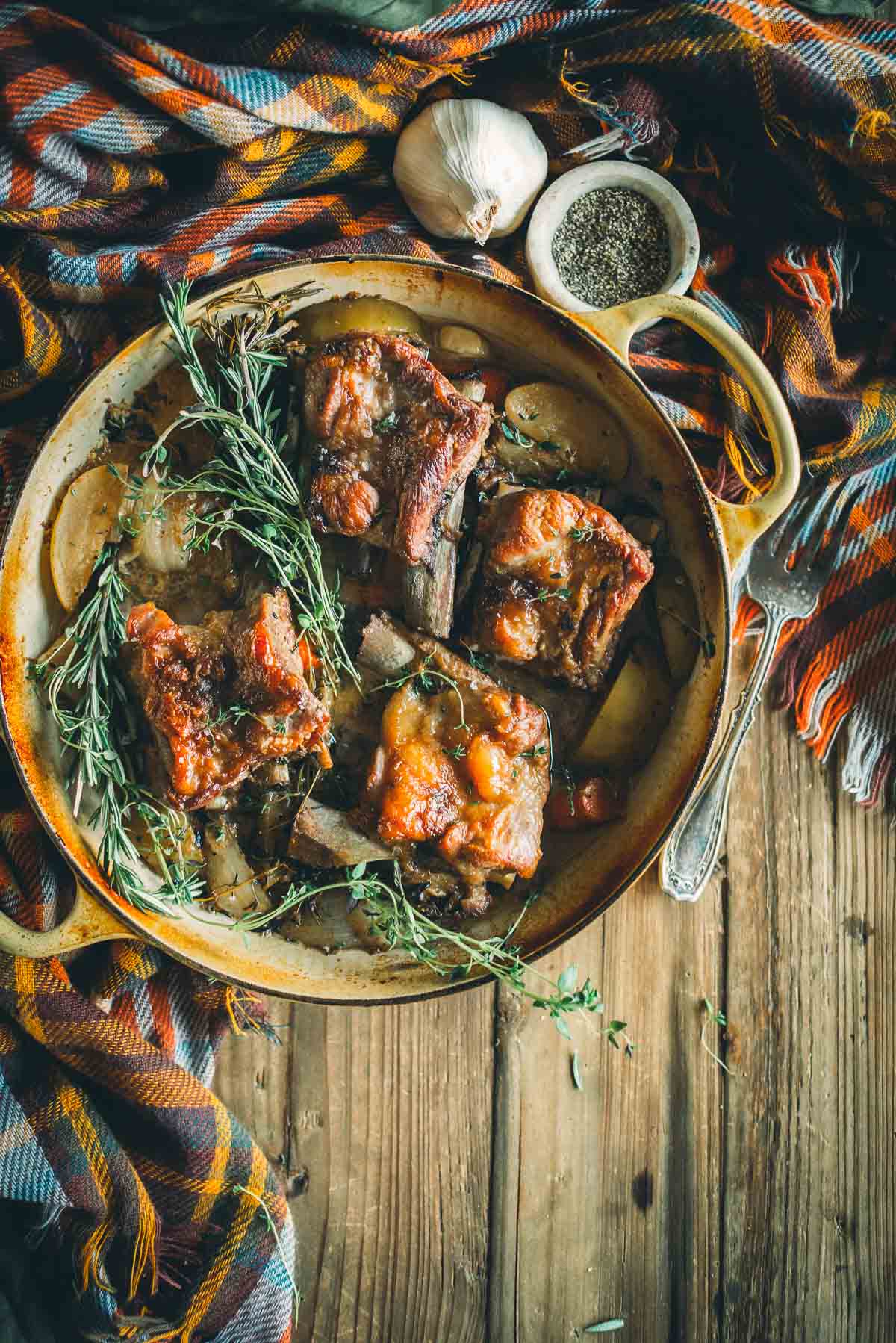
Cider braised pork short ribs
Seared in a Dutch oven, then braised at 325°F for two and a half to three hours in white wine, apple cider and Dijon with apples, onions and herbs. Fall-apart tender, with a sauce you’ll want bread for. Get the cider braised pork short ribs recipe.
🐄 Beef ribs and short ribs

Smoked beef ribs
Beef plate ribs, the big three- and four-bone dino ribs, seasoned with salt, pepper and garlic, smoked at 225 to 250°F, wrapped at 165 to 170°F and pulled at 205 to 210°F. Tender enough to pull apart or slice between the bones. Get the smoked beef ribs recipe.

Smoked beef short ribs
English-cut plate short ribs on a pellet grill at 225°F for about five hours, unwrapped and spritzed, until a probe slides in at 203 to 205°F. Smoky bark outside, fall-off-the-bone inside. Get the smoked beef short ribs recipe.

Sous vide short ribs
Seared, bagged and held at 145°F for 48 hours for fork-tender meat, or about 190°F for 12 to 14 hours if you want it softer, then finished with a red wine sauce made in the same pan. Get the sous vide short ribs recipe.

Beer braised 48 hour sous vide short ribs
Boneless short ribs with a dark beer and broth braise, held at 135°F for 48 hours. They slice like steak with a pink center, the short rib for anyone who wants bite. Get the beer braised 48 hour sous vide short ribs recipe.
🐑 Lamb ribs

Oven roasted lamb ribs
Lamb riblets from the belly end, rubbed with rosemary, anise and coriander, braised covered at 400°F in white wine with fennel and lemon, then uncovered and basted until they hit 190°F. Fall-off-the-bone in about an hour, no smoker needed. Get the oven roasted lamb ribs recipe.

Smoked lamb ribs
Riblets rubbed with berbere, smoked at 275°F, wrapped in foil at about 160°F, taken to 190 to 195°F and seared at 400 to 450°F with barbecue sauce. Fall-off-the-bone in under three hours. Get the smoked lamb ribs recipe.

Grilled lamb ribs
A two-zone charcoal fire and a za’atar and cumin rub: bone side down over direct heat, then fat side down over indirect heat, pulled at 180 to 185°F and brushed with maple syrup. Under an hour on the grill. Get the grilled lamb ribs recipe.
🥩 Meat Nerd Tips
- Pull the membrane. That papery sheet on the bone side turns leathery in the smoker and blocks your rub. A butter knife under one corner and a paper towel for grip gets it off in one piece.
- Probe between the bones. Bone reads hotter than meat, so a probe resting on it will tell you the rack is done before it is.
- Sauce late. Sugary sauce scorches over long cooks, which is why our recipes brush it on in the last stretch.
- Wrap for speed, skip it for bark. Foil gets you to tender faster. An unwrapped, spritzed rack takes longer and keeps a firmer crust.
- Slice bone side up. You can see exactly where each bone runs, so the knife goes between them instead of into them.
Quick Summary
Competition judges want ribs with some firmness and no mush, but fall-off-the-bone is a fine choice at home if you make it on purpose. Pull pork ribs around 190 to 200°F for bite and 205 to 210°F for fall-apart, wrap in foil to speed tenderness, and confirm with a Thermapen between the bones. Then pick from 18 GC rib recipes for pork, beef and lamb.
❓ FAQs
Pork ribs are safe at 145°F, but they stay chewy until the collagen breaks down. We pull them around 190 to 200°F for a clean bite and 205 to 210°F for fall-off-the-bone, checked with a Thermapen between the bones.
It pushes them that way. Foil traps steam and braises the meat, so wrapped ribs get tender faster and softer overall, with less bark. Leave them unwrapped and spritz them if you want more chew.
Baby backs come from higher on the hog, up near the backbone, and have smaller, curved bones. Spare ribs sit lower toward the belly and carry more fat, and St. Louis ribs are spare ribs trimmed into a neat rectangle.
Yes. A covered braise does the work a smoker does with time: our oven roasted lamb ribs braise at 400°F before browning, and our cider braised pork short ribs go low in a Dutch oven at 325°F for about three hours.
📚 Keep reading
- How to trim ribs, membrane off and spare ribs squared up before the smoke
- Types of pork ribs, baby backs, spare ribs, St. Louis and country-style sorted out
- All our smoking recipes, for when the ribs are gone and the smoker is still hot
Hungry for more? Subscribe to our newsletter and become part of the world’s best meat community! From grilling tips to smoky secrets, we send you the best recipes, guides, and expert advice to master every cut.