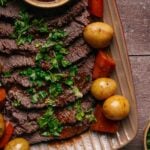
Red Wine Braised Brisket
Fork tender brisket, potatoes and carrots that drank up the red wine braise, and a silky gravy blended right in the pot. Whoever gets the end piece owes the cook a favor.
Servings: 8 servings
Calories: 550kcal
Equipment
- Large oval Dutch oven
- Kitchen twine
- Wooden spoon
- Instant read meat thermometer or oven safe probe thermometer
- Slotted spoon
- Immersion blender
- Sharp carving knife
- large cutting board
Ingredients
- 4 pounds beef brisket flat with fat trimmed to ¼ inch
- 1 tablespoon kosher salt
- 1 ½ teaspoons black pepper
- 2 tablespoons avocado oil
- 2 yellow onions roughly chopped
- 2 celery stalks chopped
- 6 cloves garlic peeled and smashed
- 3 tablespoons tomato paste
- 2 cups dry red wine such as Merlot or Cabernet Sauvignon
- 2 cups low sodium beef broth
- 1 tablespoon Better Than Bouillon roasted beef base
- 2 tablespoons brown sugar
- 4 sprigs fresh thyme
- 2 sprigs fresh rosemary
- 2 bay leaves
- 3 medium carrots peeled and cut into 2-inch pieces
- 1 ½ pounds baby gold potatoes
- horseradish gremolata for garnish, or chopped fresh parsley
Instructions
Prep the Brisket
- Preheat oven to 300°F. Pat the brisket thoroughly dry with paper towels. Trim away any thick, hard sections of fat, leaving a ¼-inch layer. Season all over with salt and black pepper.
- Gather the fresh thyme, rosemary, and bay leaves into a bundle. Secure with kitchen twine, making sure the bay leaves are held in place. Set aside.
Sear and Build the Braise
- Heat the avocado oil in a large Dutch oven over medium high heat. Place the brisket fat side down and sear for approximately 5 to 6 minutes without moving it, until well browned. Flip and sear the opposite side for another 4 to 5 minutes.
- Reduce the heat to medium. Add the onions and celery to the Dutch oven. Cook for 4 to 5 minutes, stirring occasionally. Add the smashed garlic cloves and cook for another 30 seconds.
- Stir the tomato paste into the veggies and cook for 2 minutes, stirring frequently, until the paste darkens slightly.
- Pour in the red wine and increase the heat to medium high. Scrape the bottom of the Dutch oven with a wooden spoon to release the browned bits. Bring to a simmer and cook for 4 to 5 minutes, until the wine has reduced slightly.
- Stir in the beef broth, beef base, and brown sugar until dissolved. Add the herb bundle and bring the mixture to a simmer.
Braise Until Tender
- Return the brisket to the Dutch oven, fat side up. The liquid should come partway up the sides of the meat. It doesn't need to cover the brisket. Cover and transfer to the oven. Braise for 2 hours.
- After two hours, add the carrots and potatoes to the braising liquid, arranging them around the brisket. Return covered to the oven. Continue braising for another 1 to 2 hours, until the brisket is tender.
- Begin checking the internal temperature after 3 hours of braising. Insert a meat thermometer into the thickest part. The brisket will generally become tender between 195°F and 205°F. Once it reaches 195°F, check the texture by inserting the thermometer probe into several areas. The probe should slide into the meat with very little resistance. Continue braising and checking every 20 to 30 minutes until tender, even if it takes longer than 4 hours total.
Rest and Make the Gravy
- Transfer the brisket to a large cutting board. Tent with aluminum foil and let rest for at least 30 minutes before slicing.
- Remove the herb bundle from the Dutch oven. Remove the carrots and potatoes with a slotted spoon and set aside. Skim some of the fat from the surface of the braising liquid. Use an immersion blender to blend the onions, celery, garlic, and braising liquid until smooth. Place the Dutch oven over medium heat and simmer uncovered for approximately 5 to 10 minutes, stirring occasionally, until the gravy coats the back of a spoon. Taste for seasoning.
Slice and Serve
- Identify the direction of the muscle fibers and slice the brisket against the grain into approximately ¼-inch-thick slices.
- Arrange the brisket on a serving platter, slightly overlapping them. Place the carrots and potatoes around the meat. Spoon some of the gravy over the brisket and garnish with chopped fresh parsley. Serve immediately with additional gravy on the side.
Notes
- Schmaltz can stand in for the avocado oil for a richer sear. Got a jar from making schmaltz? Use it here.
- Finish with horseradish gremolata, or keep it minimal with chopped flat-leaf parsley.
- Doneness is about feel: around 195°F to 200°F the probe slides in with little resistance and the meat gives when twisted but holds together. Much past 205°F it starts to shred.
- Make ahead: chill the brisket overnight in its braising liquid, lift off the set fat, slice cold against the grain, and reheat the slices covered in the defatted sauce at 325°F to 350°F for 30 to 45 minutes. Straight from the fridge it may be too firm to slice by hand, so use an electric knife or long slicer, or let it sit out 20 to 30 minutes first.
- Cooking time depends on the thickness of the brisket, not just its weight. If it isn't tender after 4 hours, keep braising in 20 to 30 minute rounds and pull the potatoes and carrots once they're cooked.
- Too thin, simmer the gravy longer. Too thick, stir in a little warm beef broth.
Nutrition
Calories: 550kcal | Carbohydrates: 27g | Protein: 51g | Fat: 21g | Saturated Fat: 6g | Polyunsaturated Fat: 1g | Monounsaturated Fat: 10g | Cholesterol: 141mg | Sodium: 1343mg | Potassium: 1445mg | Fiber: 3.5g | Sugar: 7g | Vitamin A: 3962IU | Vitamin C: 22.5mg | Calcium: 50mg | Iron: 5.4mg